What Exactly Is V2X Vehicle-to-Everything? Can a “God’s-Eye View” Help Vehicles Avoid Dart-Out Crashes and Chain Rear-End Collisions?
Author: David J. Brenner| Reading time: 12 minutes | Last updated: April 24, 2026
Even the most expensive sensor suite on a vehicle is as powerless as the human eye when facing a wall, a bus, or a row of parked SUVs.
This isn’t a sensor deficiency. It’s a law of physics—electromagnetic waves cannot penetrate solid obstacles.
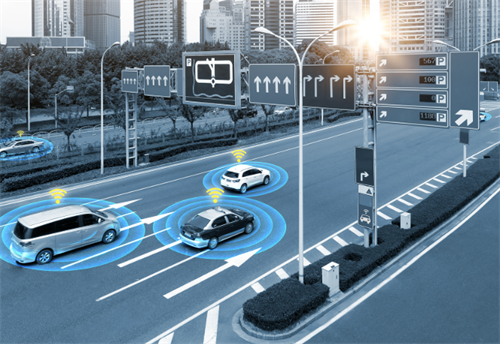
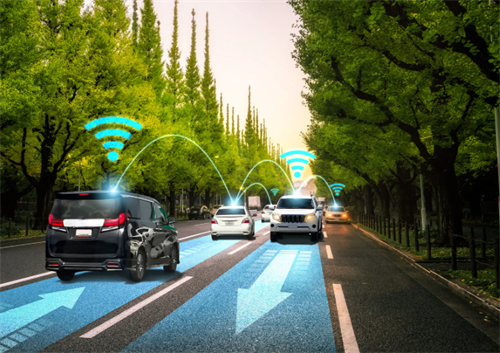
V2X technology aims to break out of this physical cage. Instead of “seeing,” it works by “listening” and “talking.” Vehicles, roadside infrastructure, and other road users exchange information over radio waves. This lets them effectively perceive targets hidden from direct line of sight.
1. What Kind of Technology Is V2X, Exactly?
V2X is fundamentally a communication architecture, not a sensing technology. Onboard radar and cameras belong to the “perception layer.” They detect the environment and identify objects. V2X belongs to the “cooperation layer.” It lets road users tell each other about position, speed, driving intentions, and potential hazards. These two solve fundamentally different problems.
Today, global V2X standards have largely converged on the C-V2X path. Two milestones stand out.
First, in 2020 the U.S. Federal Communications Commission (FCC) reallocated the 5.9 GHz band previously set aside for DSRC to C-V2X. This effectively ended the spectrum battle at the regulatory level.
Second, the 3GPP defined the 5G NR-V2X specification in Release 16. This enabled direct communication with higher throughput, greater reliability, and lower latency. ETSI then refined the profile for 5G NR-V2X sidelink direct communication in specification TS 103 939. This gave the industry a standardized guarantee of multi-vendor interoperability.
On the device side, a key test took place in February 2026. Test equipment provider Keysight, together with chipset firms Ettifos and Autotalks, completed the world’s first 3GPP Release 16 sidelink radio interoperability test, as announced jointly by the companies. This marked a clear step toward commercial pre-deployment of 5G-V2X chips and modules.
To understand V2X, it helps to separate two communication modes.
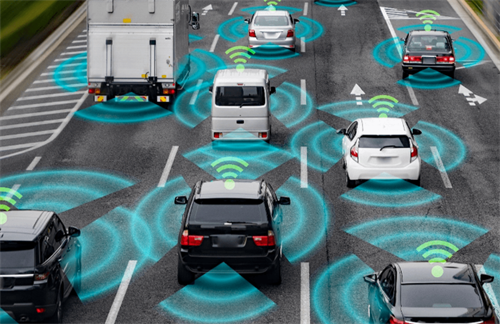
The first is PC5 direct communication. Vehicles and roadside units (RSUs) exchange information directly over short to medium distances, without relying on cellular network coverage. Latency is typically under 10 milliseconds. This is the core channel for safety applications like collision warnings and emergency brake alerts.
The second is Uu network communication. Vehicles connect to the cloud via 4G/5G base stations to get broader traffic information—road conditions, weather, signal phase and timing. Here latency is higher but context is richer.
A common misconception should be cleared up: 5G is a wide-area cellular technology. V2X’s PC5 is a short-range direct communication technology. They complement each other; they do not replace each other.
V2X doesn’t transmit video streams. It sends structured messages. Take the Basic Safety Message (BSM): a vehicle broadcasts its GPS position, speed, heading, acceleration, and brake status about 10 times per second. Receiving units then calculate collision risk over the next few seconds and can issue a warning.
2. Why Dart-Out Crashes and Chain Rear-End Collisions Defeat Standalone Sensors
A dart-out crash is exactly what it sounds like—a pedestrian, cyclist, or vehicle suddenly emerges from behind an obstacle.
A chain rear-end collision is a problem of accumulated reaction time. The lead car brakes hard. The following car perceives the event late and reacts. The car behind that one reacts even later. A chain reaction of impacts follows.
Both scenarios share a common feature: before the moment of collision, the target simply does not exist in the sensor’s field of view.
Cameras and millimeter-wave radar all operate under line-of-sight conditions. They cannot see what’s behind an obstruction, and they cannot predict it. This is a structural blind spot of standalone vehicle intelligence.
Consider an AEB system. Under good visibility, a typical AEB system needs roughly 500 milliseconds to a full second from target confirmation to emergency braking. But when a target suddenly appears from behind a parked truck, that window is compressed to less than 200 milliseconds. At that timescale, even the best braking systems can often only mitigate the collision rather than avoid it entirely.
The scale of the problem is sobering. According to the National Highway Traffic Safety Administration’s early estimates, about 8,650 people died in U.S. motor vehicle crashes in the first quarter of 2025. While slightly lower than the previous year, the absolute number remains disturbingly high. This is the backdrop against which V2X is being evaluated.
3. The “Two-Stage Braking” Logic—How V2X Makes a Real Engineering Difference
Discussions about the safety value of V2X tend to fall into two extremes: exaggerated claims that it’s a “zero-accident solution,” or dismissals that it’s useless until nearly every vehicle has it. Neither is accurate.
The most promising V2X safety strategy right now is a “two-stage braking” architecture. This concept has been systematically quantified.
In a 2025 study published on arXiv, researchers took real-world crash scenarios from the German GIDAS in-depth accident database and simulated the performance of a camera-only AEB system against a V2X-enhanced braking system. (Zimmermann et al., arXiv:2506.10535, 2025)
Here is how the two-stage architecture works.
Stage one is V2X-triggered partial braking. Even though the sensors haven’t yet seen the hidden target, the system knows from direct communication that a threat is approaching and proactively slows the vehicle. This buys a critical extra time window.
Stage two is sensor-triggered emergency braking. Once the target enters the sensor’s field of view, AEB kicks in.
The study found that the V2X-enhanced system showed measurable safety gains over the camera-only AEB baseline.
The beauty of this design is that V2X isn’t asked to replace the sensors. It simply moves the first brake intervention forward by several hundred milliseconds. In a dart-out crash, that is exactly the window that determines whether a collision can be avoided.
Of course, the technology has a non-negotiable prerequisite in the real world. At least one party—the other vehicle, a device carried by the pedestrian, or the roadside infrastructure—must be equipped with V2X and actively transmitting. In the current low-penetration phase, blind spots where V2X offers no help are still widespread.
4. Current Capabilities and Limitations
Some consumers might assume that if V2X can “see” a vehicle around a curve, it should be able to prevent any kind of collision. That is an over-extrapolation.
In practice, V2X collision warning and intervention capability is constrained by several very concrete factors.
Relative speed and beacon frequency matter. If two parties are approaching each other at high speed and the BSM transmission rate is on the low side, collision probability estimates can carry errors, leading to false positives or missed alarms.
Positioning accuracy is another factor. Consumer-grade GNSS accuracy is meter-level under open sky, and it can be worse in urban canyons. This affects the system’s ability to judge whether two vehicles are truly on a collision course.
Penetration is the third constraint. Roadside infrastructure and onboard terminal coverage determines how large the useful “god’s-eye view” radius can be. In areas with sparse deployment, that radius shrinks significantly.
For chain rear-end collisions, however, the logic is more straightforward. The moment the lead car brakes hard, its BSM data packet is broadcast over direct communication. A V2X-equipped trailing vehicle can receive that information within milliseconds and trigger a warning or pre-braking. The information chain no longer depends on the human physiological delay of “see brake lights → react → hit the brake pedal.” This breaks the formation conditions for a chain collision.
5. North American Deployment: From Pilot Corridors to Early Commercialization
The overall picture of U.S. V2X deployment can be summarized like this: technical standards are set, spectrum is allocated, but infrastructure coverage remains concentrated in individual cities and interstate corridors. It’s not yet a continuous network.
Several representative projects show the current state.
In California, Caltrans deployed a total of 76 C-V2X RSUs along the I-5 (14 miles) and I-15 (20 miles) corridors in San Diego County, according to agency project documentation. These units support basic safety messages, queue warnings, and work zone alerts.
At the ITS World Congress in September 2025, Atlanta officially became the first U.S. C-V2X “Day One Deployment District,” as announced by 5GAA. Member automakers and suppliers ran a series of application demonstrations in real city traffic.
The University of Michigan Transportation Research Institute (UMTRI), in partnership with the City of Ann Arbor, is expanding its C-V2X deployment to 51 city sites. Per UMTRI and federal grant records, the project has a total investment of $12.7 million, including a $9.85 million federal grant.
In College Station, Texas, a U.S. DOT SMART grant project deployed C-V2X RSUs at five intersections and onboard units on 49 transit buses, specifically targeting pedestrian and cyclist safety warnings. Total project investment was about $1.9 million, as detailed in the grant’s project summary.
On the in-vehicle side, large-scale factory installation is still ramping up. According to the 5GAA “Visionary 2030 Roadmap” (2025), 5G-V2X is expected to enter mass commercial deployment starting in 2026. Currently, vehicles with this technology are predominantly Chinese brands. The North American market is expected to see more model options in the 2026–2027 timeframe.
6. How Should Consumers Think About V2X? A Practical Framework
For consumers, V2X is neither something to be anxious about nor something to ignore.
If you’re shopping for a new vehicle today, here are three practical points to check.
First, find out whether the model comes with a factory-installed C-V2X module, and confirm whether your region has roadside unit coverage. Both the feature and the infrastructure must be present for it to work.
Second, understand that V2X is a safety redundancy layer, not a replacement for AEB. It’s not “one or the other”—it’s “both together.”
Third, check your city’s V2X deployment plans through your local DOT or industry resources. Information beats guessing.
For owners of older vehicles, aftermarket onboard units (OBUs) are an option. But the range of compatible vehicles is still narrow, installation requires professional work, and the benefit is limited in areas without RSU coverage.
It’s also worth noting that the traffic information from a smartphone navigation app and the safety messages processed by V2X operate on different planes. One deals with road conditions; the other with collision risk. They are not interchangeable.
The value of V2X isn’t that it’s “smarter” than sensors. It’s that it can perceive what sensors cannot see.
A single vehicle’s sensing system has reached the physical boundary of what it can do. Cooperative perception—letting the transportation system share information as a whole through V2X—offers a path to information that lies beyond that boundary. This is data that no amount of additional sensors can reach. This won’t be completed in a single year, but the direction is already clear.
FAQ
1. What is the relationship between V2X and 5G? Can I use V2X without 5G?
Yes. Basic V2X safety functions rely on PC5 direct communication and do not depend on cellular network coverage. 5G-Uu mode provides enhanced services such as high-definition map updates and remote teleoperation.
2. If my car is the only one on the road with V2X, does it still help?
It helps, but to a limited extent. At an intersection or work zone equipped with an RSU, even a single vehicle can receive broadcast information from the infrastructure. However, in areas without RSU coverage where no other vehicle has V2X, the benefit is substantially reduced.
3. Is V2X data secure? Can it leak my location?
V2X messages contain no personal vehicle identification. They use a pseudonym certificate rotation mechanism and do not carry license plate numbers, VINs, or other personally identifiable information. That said, the security architecture must continue to evolve to meet emerging cybersecurity challenges.
4. How does V2X relate to the ADAS sensors already on my vehicle?
They are complementary. Sensors handle “seeing”; V2X handles “listening.” The two work in parallel and together form a perception redundancy layer. V2X cannot replace sensors, and sensors cannot do what V2X does.
References:
[1] 5GAA, “Visionary 2030 Roadmap,” 2025.
[2] J. Zimmermann et al., “Analyzing the Performance of a V2X-Enhanced Braking System in Real-World Crash Situations,” arXiv:2506.10535, 2025.
[3] ETSI TS 103 939, “Intelligent Transport Systems; Profile for 5G NR-V2X Sidelink Direct Communication; Release 2,” 2026.
[4] U.S. Department of Transportation, “I-24 SMART Corridor V2X Roadmap,” ITS Knowledge Resources, 2025.
[5] 5GAA, “C-V2X Technology Reaches U.S. Milestone — First Day One Deployment District at ITS World Congress 2025,” Automotive World, 2025.
Author: David J. Brenner
SAE International member and IEEE Intelligent Transportation Systems Society member;
Over 12 years of experience in automotive electronics and V2X communication system integration;
Has participated in technical evaluations of connected vehicle pilot projects across multiple U.S. states;
Holds several patents in vehicular communication systems;
Currently an independent automotive technology consultant;
Disclaimer:
This article reflects the author’s personal observations and knowledge based on publicly available research and industry developments. It does not constitute investment advice or vehicle purchasing recommendations. Vehicle models, products, and features mentioned are subject to official manufacturer announcements. V2X technology deployment, infrastructure coverage, and regulations vary considerably by country and region. Readers should refer to local conditions.
Related Articles:
1. L3 Autonomous Driving Accidents: Who Is Actually Liable? https://zhongtaiserver.zhongtongtec.com/storage/WebsiteAdmin/view/2026-04/autotriad.com/driving/l3-autonomous-driving-accidents-who-is-actually-liable.html
2. Autonomous Driving Cybersecurity: Is the Risk of Remote Vehicle Hijacking Real? https://zhongtaiserver.zhongtongtec.com/storage/WebsiteAdmin/view/2026-04/autotriad.com/driving/autonomous-driving-cybersecurity-is-the-risk-of-remote-vehicle-hijacking-real.html
Recommended for you: