Fusion's Biggest Breakthrough Isn't in the Reactor
Why AI Data Centers May Have Solved Fusion's Oldest Problem: Finding a Customer
By Elena Kovacs
Emerging Technology Correspondent
Last Updated: June 9, 2026
Reading Time: 14 min read
The two most closely watched fusion news stories of 2026 appear, on the surface, to be about the same thing.
The International Thermonuclear Experimental Reactor (ITER) announced that its first plasma experiment has been postponed to 2034, while deuterium-tritium operations have been delayed until 2039—nine years later than the 2016 baseline schedule, with approximately €5 billion in additional costs.
Meanwhile, Helion Energy announced that, building on the 50 MW Power Purchase Agreement (PPA) signed with Microsoft in May 2023, its Polaris prototype achieved a plasma temperature of 150 million degrees Celsius in February 2026 and became the first privately funded fusion device to observe measurable deuterium-tritium fusion reactions.
Both stories are talking about "progress in fusion."
But if we look more closely, the most important change is not happening inside the reactor. It is happening outside it.
For decades, the fusion industry has been searching for stronger magnetic fields, higher temperatures, and longer confinement times.
In 2026, for the first time, it began seriously searching for customers.
That may be more important than any laboratory record.
I. What the Fusion Industry Has Really Been Missing for the Past Fifty Years
A Problem Rarely Discussed in Public
The fusion industry has long exhibited a strange characteristic: the scientific roadmap has become increasingly clear, while the commercial roadmap has remained remarkably vague.
Many projects can explain how fusion is generated, how plasma is confined, and how the energy gain factor (Q) can be improved.
Far fewer can answer questions such as:
Who will buy the electricity?
Why will they buy it?
At what price?
Who will bear the risk?
ITER is fundamentally a scientific project.
Its goal is to demonstrate that fusion is technically feasible from an engineering perspective, not to demonstrate that fusion can become a business.
Those are two very different things.
When ITER Director-General Pietro Barabaschi announced the new baseline schedule in July 2024, he explicitly stated that the originally planned 2025 "first plasma" milestone was "largely symbolic" and had limited scientific value.
Under the revised plan, research operations are delayed until 2034, but the machine will begin with a much more complete configuration.
The postponement reflects a combination of supply-chain challenges, engineering quality-control issues, and regulatory requirements.
The deeper question is this:
Even if ITER successfully achieves deuterium-tritium operations in 2039, what happens next?
Who buys the electricity?
How will it be connected to the grid?
Can the cost per kilowatt-hour compete with existing energy sources?
The answers to these questions may be more difficult than plasma physics itself.
ITER's members—China, the European Union, India, Japan, South Korea, Russia, and the United States—must eventually decide whether continued investment is justified.
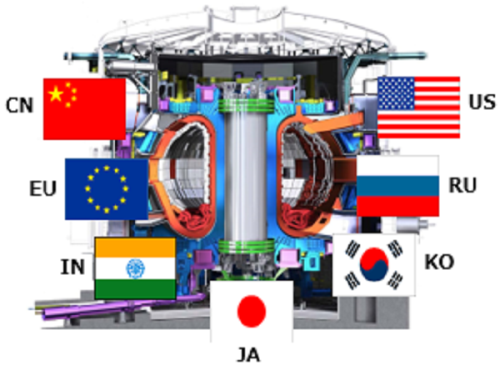
ITER's members
Yet ITER's in-kind contribution model makes the total cost difficult to calculate precisely.
This challenge is not unique to ITER.
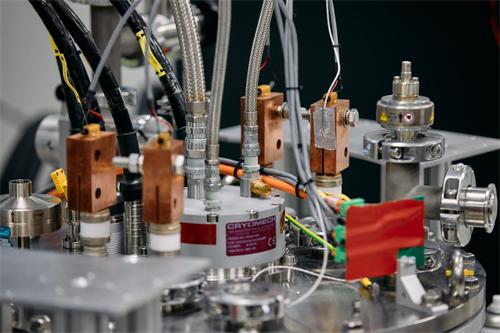
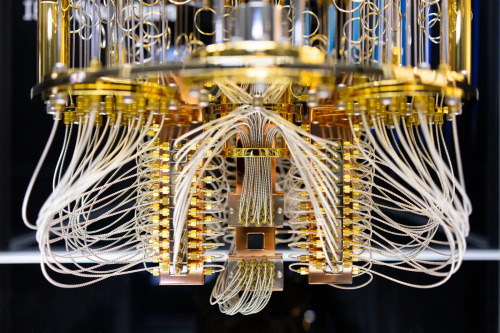
Quantum computing, brain-computer interfaces, and commercial spaceflight have all displayed similar characteristics.
A field can have world-class scientists, billions of dollars in funding, and clearly defined physical objectives, yet still struggle to answer the most basic business question:
Who is the customer?
Troy Carter, Director of the UCLA Institute for Plasma Science and Technology, offered a straightforward observation:
"Look at how people vote with their feet. We can't wait any longer."
By the mid-2030s, he argued, "that flashbulb moment comes a little too late."
II. AI Data Centers Become an Unexpected Customer
Fusion Never Found the Energy Market It Was Waiting For—AI Created One Instead
For decades, the fusion industry has been waiting for the energy market to need it.
What arrived instead was not the energy industry, but the AI industry.
According to the 2024 United States Data Center Energy Usage Report published by the U.S. Department of Energy's Lawrence Berkeley National Laboratory, American data centers consumed approximately 176 TWh of electricity in 2023, accounting for 4.4% of total U.S. electricity consumption.
That figure has tripled over the past decade—from 58 TWh in 2014 to 176 TWh in 2023.
The report projects that by 2028, data-center electricity consumption could reach between 325 and 580 TWh, representing between 6.7% and 12% of total U.S. electricity demand.
This rate of growth far exceeds the pace at which traditional power infrastructure can expand.
Building transmission lines takes time.
Approving natural-gas plants takes time.
Building nuclear power plants takes even longer.
Meanwhile, demand for AI training and inference continues to grow exponentially.
The Stargate project, jointly backed by OpenAI, SoftBank, and Oracle, aims to build 10 GW of AI infrastructure in the United States, with total planned investment exceeding $400 billion.
A single hyperscale data center can consume between 100 MW and 500 MW of power.
A flagship campus such as Stargate could exceed 1 GW—enough electricity to power a small city.
The challenge becomes even more complicated because AI workloads consume electricity in a fundamentally different way from traditional data centers.
Traditional data-center demand is generally slow-moving, stable, and correlated with human activity.
Modern AI training campuses, by contrast, may require between 2 and 10 GW of power, with demand fluctuations that are both rapid and substantial.
Grid reliability officials have compared these facilities to steel mills.
Such volatility directly challenges the "load diversity" assumptions that have shaped grid planning and operations for more than a century.
Against this backdrop, technology companies have begun actively searching for future sources of power.
The Microsoft–Helion agreement is symbolic.
But what makes it truly interesting is not the technology itself—it is the commercial structure behind it.
Helion CEO David Kirtley confirmed in an interview with CNBC that the agreement is a "standard PPA arrangement containing financial penalty provisions for non-delivery."
Constellation Energy participates as the power marketer.
If Helion fails to deliver fusion-generated electricity, Constellation will supply power from alternative sources.
The penalties paid under the agreement become part of Helion's cost of non-performance.
This means Microsoft is not actually purchasing fusion electricity.
Microsoft is purchasing the possibility that fusion electricity may exist, together with a forward commitment backed by financial consequences.
For a technology company valued at more than $3 trillion, the risk exposure is relatively limited.
Yet the agreement provides Microsoft with an anchor point for future data-center planning and grid coordination.
In electricity markets, a forward commitment with penalty clauses is often more valuable than having no commitment at all—even when the technology behind that commitment has not yet been proven.
Microsoft Vice Chair and President Brad Smith's remarks when announcing the agreement reveal a great deal:
"Helion's work supports our own long-term clean energy goals and will help establish a new, efficient way to bring more clean energy to the grid faster."
The key phrase is not "fusion has succeeded."
The key phrase is "help establish."
Microsoft was not celebrating a technological breakthrough.
It was helping create a future market.
III. Once Customers Appear, the Industry's Metrics Begin to Change
From Physics Metrics to Market Metrics
Historically, fusion companies tended to showcase the same types of achievements:
Temperature.
Energy gain.
Confinement time.
Plasma stability.
Today, investors increasingly ask different questions.
Do you have customers?
Do you have contracts?
Do you have pre-purchase agreements?
Who is willing to share the risk?
This represents a shift in the industry's underlying logic.
When there are no customers, capital is betting on science.
Once customers appear, capital begins betting on markets.
The technology may remain exactly the same.
The valuation framework does not.
Helion provides perhaps the clearest example.
When the company signed its PPA with Microsoft in May 2023, it had not yet achieved net energy output.
When Polaris reached 150 million degrees Celsius in February 2026, the company was still conducting tests using deuterium-tritium fuel, even though its eventual commercial pathway relies on deuterium-helium-3 fuel.
At the same time, other fusion companies have been accelerating their commercial strategies.
In June 2025, Commonwealth Fusion Systems (CFS) signed a 200 MW power purchase agreement with Google.
In September of the same year, it signed a PPA worth more than $1 billion with the Italian energy company Eni, securing power commitments for its planned 400 MW ARC fusion power plant in Chesterfield County, Virginia.
CFS expects its SPARC demonstration device to achieve net fusion energy (Q > 1) in 2027.
These agreements do not mean fusion technology has matured.
They mean that the perceived risk associated with fusion has fallen far enough that investors can begin shifting their focus from scientific feasibility to commercial execution.
The significance of that transition should not be underestimated.
IV. Fusion Is Experiencing Its Own SpaceX Moment
Contracts Matter More Than Demonstrations
The development of commercial spaceflight did not begin with a breakthrough in rocket technology.
It began when customers appeared.
On August 18, 2006, NASA announced that SpaceX had been awarded a Commercial Orbital Transportation Services (COTS) contract worth $278 million to support the development of the Falcon 9 launch vehicle and Dragon cargo spacecraft.
At the time, SpaceX was in a precarious position.
The Falcon 1 rocket had already failed in its first three launch attempts, and the company was approaching bankruptcy.
In a 2018 interview with 60 Minutes, Elon Musk later recalled:
"We were almost bankrupt."
The structure of the COTS contract was unusual.
NASA was not directly purchasing launch services.
Instead, it provided milestone-based funding to support technology development.
The money enabled SpaceX to continue iterating.
The company eventually completed COTS Demo Flight 1 in December 2010 and successfully docked with the International Space Station in May 2012.
NASA subsequently awarded Commercial Resupply Services (CRS) contracts worth $1.6 billion, later expandable to as much as $3.1 billion.
Many people remember SpaceX's first successful launch.
What they often overlook is that the NASA contract was the event that truly changed the industry's trajectory.
A contract means cash flow.
It means financing capacity.
It means long-term planning.
It means supplier confidence.
It means the ability to build an industrial ecosystem.
Many people assume that the turning point in a frontier technology comes from a technical breakthrough.
History is often less straightforward.
The turning point in commercial spaceflight was not the first successful launch.
The turning point in cloud computing was not the invention of virtualization.
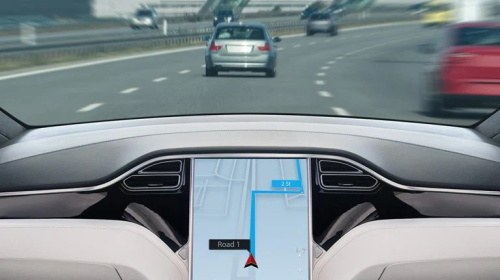
The turning point in autonomous driving may not ultimately be a breakthrough in perception algorithms.
Across many frontier technologies, what changes the trajectory of an industry is often not the next laboratory record.
It is the arrival of the first customer willing to take risk.
For fusion, that is what makes the Microsoft–Helion agreement so significant.
Its importance is not that it guarantees fusion will succeed.
Its importance is that it allows the industry to see, perhaps for the first time, what the market might look like if fusion does succeed.
In that sense, the Microsoft–Helion PPA serves a role similar to NASA's early contracts with SpaceX.
It does not prove that fusion has succeeded.
It proves that someone is willing to place a bet on a world in which it succeeds.
That changes investment logic.
It changes talent flows.
It changes technology priorities.
It changes the speed of the industry.
The moment a frontier technology acquires customers willing to sign long-term contracts, the incentive structure of the entire ecosystem begins to shift.
V. Why This Does Not Mean Fusion Has Already Won
The Appearance of Customers ≠ Commercial Success
It is important to emphasize that fusion still faces multiple major challenges.
Technical Challenges
Although Helion's Polaris prototype reached 150 million degrees Celsius, it has not yet achieved net electrical output.
Its distinctive field-reversed configuration (FRC) pulsed magnetic compression approach requires plasma to remain stable under extremely demanding conditions.
From a physics perspective, this remains a highly difficult problem.
Engineering Challenges
Helion's Orion commercial power plant, which is scheduled to begin operation in 2028, broke ground in Malaga, Washington, in July 2025.
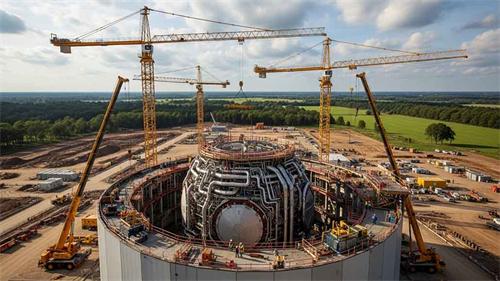
Helion Begins Work on Commercial Fusion Power Plant
However, reactor assembly has not yet begun.
The transition from a prototype system to a commercial power plant involves uncertainties in materials science, manufacturing, supply chains, and regulatory approvals.
Helion is currently constructing a 166,000-square-foot manufacturing facility intended to assemble approximately 2,500 capacitor units required for the Orion plant.
Production is not expected to begin until later in 2026.
Commercial Challenges
Even if Helion successfully generates commercial fusion power, scaling from a single demonstration project to large-scale electricity production remains an enormous challenge.
Future AI infrastructure could require tens of gigawatts of power.
That means fusion companies must prove not only that the technology works, but also that manufacturing capacity, supply chains, and deployment capabilities can scale alongside demand.
Regulatory Challenges
Fusion facilities will require regulatory frameworks that are still being developed.
These include nuclear safety licensing, waste management—even for relatively low-level radioactive waste—and grid interconnection requirements.
Helion must still obtain final approval from Washington State regulators before Orion can ultimately deliver electricity.
Microsoft signing a contract does not mean Microsoft will necessarily receive fusion-generated electricity in 2028.
Helion could still fail.
Yet that possibility does not invalidate the central argument of this article.
Because what matters most is not any single company.
What matters is that the industry itself has changed.
For the first time, genuine demand has appeared.
And the source of that demand—AI data centers—may be growing along a curve that is steeper than the progress curve of fusion technology itself.
Conclusion: The Future of Fusion May No Longer Be Determined Solely by Physicists
For the past fifty years, the central question facing fusion has been:
How do we create fusion?
Over the next decade, that question may become:
How do we serve customers?
At first glance, this sounds like a subtle change in wording.
In reality, it represents the transition into an entirely new phase of industry development.
ITER will continue to play an indispensable role.
The engineering knowledge, supply-chain experience, and plasma physics insights generated by ITER are assets that no private company could accumulate on its own.
As Max Planck Institute for Plasma Physics Scientific Director Sibylle Günter has noted:
"For the foreseeable future, we know of no project that can analyze the challenges of fusion as comprehensively as ITER."
The engineering breakthroughs already achieved by ITER remain valuable for every current and future fusion project.
At the same time, ITER's deliberate pace and Helion's speed are beginning to create a dual structure within the industry.
Government-led projects provide depth.
Commercial ventures provide speed.
Connecting the two is an unexpected customer—AI data centers willing to commit capital years before fusion electricity actually exists.
Barabaschi made a comment during the 2024 baseline announcement that many observers overlooked:
"Humanity should focus on the technologies available today."
In the context of energy policy, he may be correct.
Fusion is a solution for problems decades into the future, not necessarily for today's energy shortages.
But from a commercial perspective, that observation overlooks something important.
The moment the first customer appears, the industry's clock begins running at a different speed.
The most important event of 2026 may not ultimately be a new temperature record.
It may not be a new plasma milestone.
It may be that Microsoft, OpenAI, and a generation of fusion startups collectively demonstrated something much broader:
For most frontier technologies, what ultimately changes an industry's trajectory is not a laboratory breakthrough.
It is the arrival of the first customer willing to pay for the future.
Reporting for this article draws on public information from ITER Organization, Lawrence Berkeley National Laboratory, NASA, Helion Energy, and multiple industry publications including Science, Physics World, Axios, TechCrunch, GeekWire, Fortune, POWER Magazine, and Nuclear Engineering International.
Elena Kovacs
Emerging Technology Correspondent
Elena Kovacs focuses on frontier technologies whose commercial impact remains uncertain but potentially transformative. Her work examines where scientific breakthroughs meet engineering constraints, regulation, and economic reality.
Recommended for you