The Display Industry Has a Problem: Every Screen Technology Is Better, Yet Choosing One Is Harder Than Ever
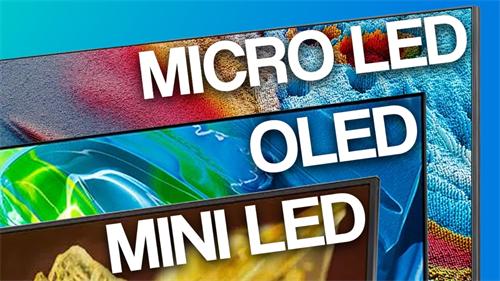
For the first time in decades, the display industry is not moving toward a single successor. Instead, three different technologies are solving three different problems.
By Sofia Laurent
Principal Computing SystemsResearcher
Last Updated: May 28, 2026
Reading Time: 7 min read
The Industry Has Broken Its Own Rules
For decades, the display industry followed a remarkably clear technological ladder. From CRT to LCD, then to LED backlighting, and finally to OLED, every generation seemed destined to become the next successor. The market would eventually reach a consensus. By 2020, nobody was seriously debating whether to buy a CRT or an LCD because the answer had long been settled.
However, when we look back from the middle of 2026, the situation has fundamentally changed.
Today's TV and monitor market has fractured in a way that would have been difficult to imagine a decade ago. Apple continues to rely on Mini-LED in its latest Studio Display XDR, deliberately avoiding OLED. Samsung Display is shipping QD-OLED panels with improved text rendering to seven major monitor brands. TCL is pushing aggressively into both low-cost printed OLED and high-value Mini-LED products. Meanwhile, MicroLED—the technology once promoted as the ultimate answer—remains something of a concept car. Everyone talks about it, but almost nobody owns one.
Why Are We Still Confused in 2026?
It is difficult to describe 2026 as a victory for any single display technology because these three major technological paths were never designed to replace one another in the first place.
In a report titled Next-Generation Display Technologies Market – Global Forecast 2026–2032, industry analysts noted that "innovation is occurring simultaneously across multiple fronts rather than along a single linear upgrade path." That observation captures the core of today's dilemma.
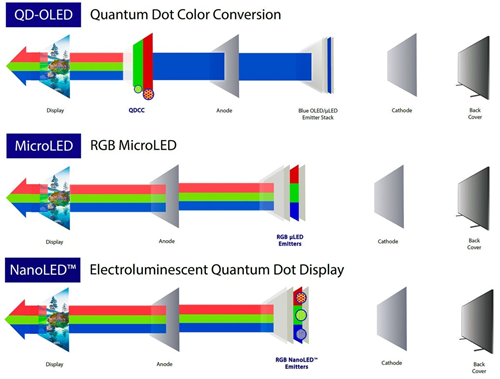
- Mini-LED was never created to replace OLED. It was designed to save LCD technology, solving problems related to brightness and cost.
- QD-OLED was developed to address the brightness limitations and color compromises of traditional OLED. It exists in pursuit of ultimate image quality.
- MicroLED aims to solve the industry's long-term endgame—eliminating burn-in while delivering extraordinary brightness. However, it still struggles with manufacturing scale and affordability.
These technologies resemble three highways being built at the same time. Their destinations are different, which means none of them can simply be declared superior to the others.
Mini-LED's Unexpected Victory
Let's go back to 2019.
At the time, much of the technology media predicted that OLED would dominate the premium display market within five years as both LG Display and Samsung Display expanded OLED production capacity. That never happened.
Instead, Mini-LED survived far longer than many expected and is increasingly becoming mainstream.
Why?
One very practical reason is burn-in anxiety.
Although modern OLED panels have become significantly more durable, long-term endurance tests conducted by organizations such as RTINGS.com continue to show that OLED displays used for static elements—taskbars, channel logos, application interfaces, and other persistent content—still face a risk of permanent image retention. For consumers planning to keep a television for seven years or longer, that possibility can feel much larger than it actually is.
Another important development emerged during 2025 and 2026: supply-chain instability.
According to reports from Display Daily, BOE experienced yield-related challenges that resulted in a substantial portion of iPhone OLED panel orders shifting back to Samsung Display. The incident served as a warning to the entire industry: relying too heavily on a single technology platform can create significant supply-chain vulnerability.
As a result, companies such as Apple began reassessing their strategies. When Apple introduced the 2026 Studio Display XDR, it did not choose OLED. Instead, it adopted a Mini-LED panel featuring 2,304 local dimming zones and peak brightness reaching 2,000 nits.
For Mac users who spend hours working with static spreadsheets, programming environments, and professional applications, that decision may be more practical than OLED's theoretically infinite contrast ratio.
Mini-LED ultimately demonstrated something important:
Sometimes, a technology that is sufficiently good and consistently reliable can be more valuable than one that is exceptional but carries compromises.
QD-OLED: The Brilliant Disruptor That Isn't Perfect
In theory, QD-OLED is almost ideal.
It combines OLED's pixel-level light control with the brightness and color advantages of quantum dots.
However, when the technology reached real-world products in 2025 and 2026, it exposed an awkward weakness:
Text clarity.
For several years, QD-OLED monitors suffered from a peculiar issue involving colored fringing around text, especially when displaying white characters on dark backgrounds. Users often noticed subtle red, green, or blue outlines.
The problem originated from QD-OLED's unique triangular subpixel arrangement, which was not fully compatible with Windows ClearType text-rendering algorithms.
In January 2026, Samsung Display announced mass production of new panels featuring a V-Stripe RGB vertical subpixel structure, claiming that the issue had been largely addressed. ASUS, MSI, and several other manufacturers quickly adopted the new panels in their latest 360Hz gaming monitors.
Yet the announcement itself acknowledged an uncomfortable reality:
First-generation QD-OLED had genuine flaws.
This perfectly illustrates one of the reasons display purchasing has become so complicated in 2026.
If you are a programmer, writer, analyst, or anyone who spends eight hours a day reading text, are you willing to accept less-than-perfect text rendering in exchange for incredible black levels during gaming sessions?
Most people are not.
That is one reason why QD-OLED has yet to unify the monitor market despite its impressive technical achievements.
MicroLED: The Technology Everyone Has Discussed for a Decade but Almost Nobody Owns
Nearly every year at CES, there is a major MicroLED announcement.
In 2026, Samsung showcased even more impressive transparent MicroLED displays and updated versions of The Wall.
Yet whenever you read the comments, one question tends to dominate:
"When will this cost less than $5,000?"
According to analysts at Yole Group in a May 2026 report, the industry's MicroLED strategy is undergoing a significant shift.
Manufacturers increasingly recognize that challenging the mainstream television market with MicroLED in the near term would be financially impractical. Instead, the technology is pursuing a different route by targeting augmented reality (AR) glasses and automotive head-up displays (HUDs).
The logic is straightforward.
For AR glasses, brightness is not merely a feature—it is essential for usability. OLED struggles to achieve sufficient visibility under strong outdoor sunlight, while MicroLED can reach brightness levels measured in millions of nits.
Furthermore, AR displays are extremely small. Even if MicroLED manufacturing processes suffer from lower transfer yields, manufacturers can often compensate because the display area itself is tiny.
This shift highlights a classic lesson in technology commercialization:
Winning in the laboratory does not guarantee winning in the marketplace.
MicroLED is not dead.
It is simply searching for markets where no competing technology can adequately replace it.
For the average living room, however, it may remain an expensive luxury for at least the next five years.
The Real Battle Is No Longer About Image Quality
If all three technologies can already deliver image quality that is "good enough," what exactly are manufacturers competing over now?
The answer involves several far less glamorous but far more important factors:
manufacturing costs, production yields, and supply-chain control.
Today, the market is experiencing a fascinating three-way split.
Apple's Strategy: Vertical Integration
Apple is not particularly concerned with whether a product contains OLED technology.
Instead, it develops customized XDR-class Mini-LED solutions and combines them with proprietary silicon such as the A19 Pro and deep macOS integration.
The goal is not necessarily to create the best panel on paper, but to create a display experience that works seamlessly within Apple's ecosystem.
TCL's Strategy: Price Competition and Specification Pressure
TCL's 32X3A OLED+ monitor demonstrates this philosophy perfectly.
Its specifications compete with premium products, while its pricing falls to approximately $870.
TCL's strategy is straightforward: leverage China's manufacturing ecosystem and supply-chain advantages to make OLED dramatically more affordable, forcing competitors to lower prices.
Samsung's Strategy: Standards and Panel Licensing
Samsung is pursuing a different objective.
Beyond selling its own products, Samsung Display supplies QD-OLED panels to multiple brands, attempting to establish an industry perception that:
Premium monitor equals QD-OLED.
Industry reports increasingly describe this trend as a shift toward "system-level differentiation" rather than competition based solely on panel specifications.
Power efficiency is also becoming a significant battleground.
As the European Union continues tightening energy-efficiency requirements, companies such as TCL CSOT have increased investment in printed OLED technologies. In theory, printed OLED can reduce material waste and improve energy efficiency compared with conventional evaporation-based OLED manufacturing.
Conclusion: The Display War May Never End
Over the next five years, consumers may need to abandon the idea that there will eventually be a single winner.
The display industry is beginning to resemble the CPU industry.
People no longer ask whether Intel or AMD has permanently won. Instead, they ask which solution is better suited to their needs at a particular moment.
The reality of 2026 looks like this:
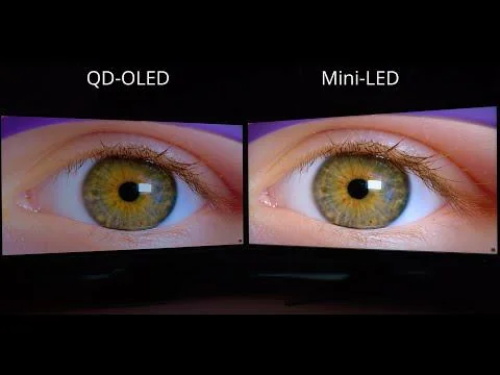
- Most people should probably buy Mini-LED. It offers the strongest balance of brightness, contrast, reliability, burn-in resistance, and declining prices.
- Purists will continue choosing QD-OLED. If you watch movies or play games in a dark room and value absolute image quality above all else, OLED remains unmatched—provided you accept the risks of burn-in and the compromises associated with text rendering.
- A very small number of affluent buyers will commission MicroLED installations. Yet those products often resemble technological monuments as much as consumer electronics.
Ten years ago, industry experts frequently predicted a future dominated by a single display technology.
Reality turned out to be far more complicated.
What we see in 2026 is a market defined by multiple coexisting paradigms, where different technologies excel in different situations and where no single solution can satisfy every need.
Perhaps that is why choosing a display has become harder than ever.
The technology itself has never been better.
The problem is that, for the first time in decades, there is no obvious answer.
References
1. The Business Research Company. (2026, January). Next-generation display global market report 2026 (Report No. 6089833). Research and Markets. https://www.researchandmarkets.com/reports/6089833/next-generation-display-market-report
2. EE Times Taiwan. (2026, January). MicroLED and MiniLED panel innovations. https://0xzx.com/2026012207186055725.html
3. Global Market Insights. (2026, March). Low power next generation display market opportunity, growth drivers, industry trend analysis, and forecast 2026-2035 (Report No. 6230457). Research and Markets. https://www.researchandmarkets.com/reports/6230457/low-power-next-generation-display-market
4. Kale, E. (2026). BOE yield crisis triggers massive iPhone OLED order shift to Samsung Display. Display Daily. https://displaydaily.com/category/daily/page/3/
5. Yole Group. (2026, March). Photonics packaging 2026. https://www.photonics.com/Articles/Photonics_Packaging_2026_Report_Coming_Soon/a70023
6. Yole Group. (2026). MicroLED 2026 - Markets and applications. https://cioe.cn/news/2745_info.html
Sofia Laurent
Principal Computing Systems Researcher
Sofia Laurent specializes in personal computing systems and user-facing hardware technologies. Her research focuses on the intersection of performance, efficiency, and product design, with particular interest in how engineering decisions translate into real-world user experiences.
Recommended for you