The Great Split in China's Semiconductor Strategy
Why National Security and Commercial Logic Are No Longer Pointing to the Same Process Node
By Lucas Reinhardt
Senior Semiconductor Analyst
Last Updated: June 15, 2026
Reading Time: 11 min read
I previously wrote an article called The End of Semiconductor Scorekeeping, arguing that process node numbers are gradually losing their ability to define competitiveness. One reader left a comment that captured a common objection:
If process nodes no longer matter, why is SMIC still pushing so hard toward 5nm? Why did Huawei publish a roadmap targeting 1.4nm by 2031?
Because in China, the idea that "nodes no longer matter" is not unfolding as a smooth transition. It is unfolding as a split.
For some participants, process nodes are becoming less important.
For others, process nodes are more important than ever.
This is not a strategic contradiction. It is the coexistence of two entirely different survival logics within the same country—and both are competing for the same pool of resources.
One Industry, Two Completely Different Answers
In the spring of 2026, two office buildings stood across the street from each other in Shanghai's Zhangjiang district.
Inside Building A, engineers at SMIC's advanced process division debated whether a fifth round of DUV multi-patterning exposure could raise yield rates from 30% to 35%. Chemical formulas covered the whiteboards. The atmosphere was tense. Everyone in the room understood that each percentage point of yield improvement could translate into hundreds of millions of dollars in cost savings.
Inside Building B, the product team of an AI chip startup discussed whether a 14nm process combined with an internally developed chiplet interconnect architecture could deliver 80% of the performance of Nvidia's H20 in inference workloads. A product manager had already run the numbers: by avoiding the pursuit of 5nm, development cycles could be shortened by eight months and tape-out costs could be reduced by 60%.
The people in both buildings ate at the same cafeteria.
Yet they were talking about fundamentally different worlds.
This is the great split inside China's semiconductor industry.
Why Advanced Nodes Still Have to Exist—Despite Their Enormous Cost
Many overseas observers misunderstand the issue.
If 5nm is expensive and suffers from low yields, why continue investing in it?
The answer is straightforward.
Advanced nodes do not exist solely to generate profits. They also serve as platforms for technology validation, talent development, industrial capability accumulation, and national security preparedness. In some strategic sectors, simply possessing the capability carries value, even when the commercial return is not yet optimal.
In May 2026, Huawei semiconductor executive He Tingbo presented a clear timeline at the IEEE International Symposium on Circuits and Systems. According to the roadmap, Huawei's first Kirin processor based on the LogicFolding architecture is scheduled to launch in autumn 2026, reaching a transistor density of 238 MTr/mm² and a clock frequency of 3.1 GHz. By 2031, Huawei aims to achieve transistor densities equivalent to a 1.4nm process.
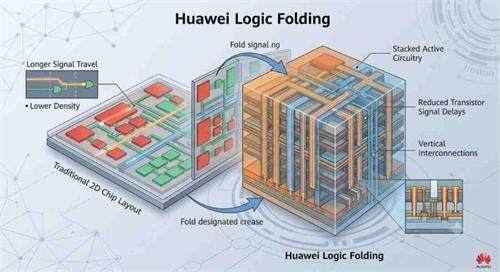
Huawei Logic Folding
For comparison, TSMC plans to begin 1.4nm production around 2028. Huawei's schedule trails TSMC by approximately three years—but given the absence of EUV lithography access, even that gap is far smaller than many industry observers expected.
Whether Huawei's approach can scale into mass production, however, is a separate question.
Achieving 1.4nm-equivalent performance in a laboratory is one thing.
Manufacturing it at commercial scale is another.
SMIC's most advanced commercially relevant capability currently remains around the 7nm class. While breakthroughs have reportedly been achieved toward 5nm, yields and production capacity have not yet reached the level required for broad commercial deployment.
Historically, industries such as commercial aviation engines, private spaceflight, supercomputing, and nuclear power have often exhibited a pattern in which capability building precedes commercial returns.
Advanced semiconductor manufacturing is increasingly displaying similar characteristics.
The difference is that investments in those industries were generally centralized and controllable.
In semiconductors, state-driven objectives are now colliding directly with commercial logic.
The Commercial Market Is Rewarding a Different Path—But There Is a Catch
For the past two decades, the industry has treated advanced nodes as synonymous with competitiveness.
The AI era has introduced a different set of bottlenecks.
Memory bandwidth.
Power consumption.
Packaging technology.
System integration.
Data center economics.
In many cases, system architecture is becoming almost as important as process node leadership.
China can manufacture 14nm or 28nm chiplets using domestic or non-U.S. equipment and then assemble them into high-performance AI accelerators through advanced 3D packaging technologies.
This "More than Moore" approach cannot fully replicate the capabilities of the most advanced chips, but it can narrow the performance gap.
Markets such as industrial control systems, automotive electronics, power infrastructure, and AI inference often care more about reliability, cost, and supply assurance than absolute peak performance.
According to TrendForce, Chinese foundries are expected to account for more than 25% of global mature-node capacity (28nm and above) by the end of 2025, with the strongest growth occurring in the 22nm and 28nm segments.
The question is no longer simply whether China can manufacture at 5nm.
The more relevant question is whether the benefits of pursuing 5nm justify the additional investment required.
That is fundamentally a commercial decision.
But there is a catch.
In early 2026, China introduced a policy requiring new foundry capacity expansions to utilize at least 50% domestically sourced equipment. Although the requirement has not been publicly codified, it is reportedly enforced through approval processes. Companies seeking approval for expansion projects must demonstrate that at least half of their equipment procurement comes from Chinese suppliers.
What does this mean for commercial operators?
It means that even when a 14nm mature-node project could theoretically achieve better yields and greater reliability using imported equipment, companies are now forced to balance domestic sourcing requirements against operational efficiency.
A former employee of Naura Technology told Reuters:
"Foundries such as SMIC used to prefer American equipment and often gave domestic suppliers fewer opportunities. After the U.S. export restrictions began in 2023, Chinese foundries had little choice but to work more closely with local vendors."
This is the first major point of friction between national security logic and commercial logic.
Policies that mandate domestic equipment usage directly alter the return-on-investment calculations of commercial projects.
Two KPI Systems Are Emerging—and Competing for the Same Resources
KPI System One: National Security Logic
Focuses on:
- Self-sufficiency
- Technological ceilings
- Strategic redundancy
- Survival under extreme conditions
Measures success by asking:
- Do we possess the capability?
- Have we reduced external dependence?
- Do we have alternatives?
KPI System Two: Commercial Logic
Focuses on:
- Cost
- Yield
- Scalability
- Customer demand
Measures success by asking:
- Is it profitable?
- Can it be delivered reliably?
- Does it create a competitive advantage?
The same project can receive completely different evaluations under these two systems.
An advanced-node initiative may be considered highly successful from a national security perspective while still being commercially unsuccessful.
Both assessments can be correct.
The most interesting analysis begins when both perspectives are simultaneously valid—but only one pool of resources exists.
Friction Point One: The Same Investment Budget
SMIC's capital expenditures reached approximately $8.1 billion in 2025, and similar spending levels are expected for 2026.
How should that money be allocated?
Advanced-node programs require enormous ongoing investment, yet yields may remain between 20% and 40%, while costs can exceed those of TSMC by 40% to 50%.
Mature-node projects offer more predictable returns.
At the same time, policy priorities push more resources toward strategically important bottlenecks.
Friction Point Two: The Same Talent Pool
China's semiconductor industry faces a talent shortage estimated at 200,000 workers, including more than 80,000 high-end technical positions.
For advanced process design below 5nm, HBM development, and 3D packaging technologies, supply-demand ratios reportedly reach 1:10.
More importantly, advanced-node teams often recruit aggressively from mature-node operations.
As a result, both sides struggle to fill positions.
Average salaries in China's semiconductor industry have risen to approximately RMB 186,000 annually, while compensation for high-end technical roles has increased by 20% to 25%.
An HR director at a packaging and testing company in Wuxi described the challenge:
"There are fewer than 500 people in China with meaningful chiplet packaging experience, while nationwide demand exceeds 5,000. Even offering annual salaries of RMB 800,000 often isn't enough to attract qualified candidates."
High-end talent is being pulled simultaneously by two competing systems.
The result is that neither side has enough people.
Friction Point Three: Identity Choices Inside the Same Company
An AI chip company receives a quotation from SMIC for a 5nm design.
The management team runs the numbers.
The 5nm option delivers approximately 15% better performance than a 14nm-plus-packaging solution.
But it costs three times more and extends delivery schedules by six months.
Then the company discovers something else.
Choosing the 14nm route would lower its rating under domestic substitution certification programs, potentially affecting access to government contracts.
At that point, the decision is no longer purely technical.
It becomes an identity choice.
When Two KPI Systems Collide: The Industry Is Entering the Era of Combinations—But Combinations Carry Their Own Costs
Over the next decade, different sectors may prioritize different technological paths:
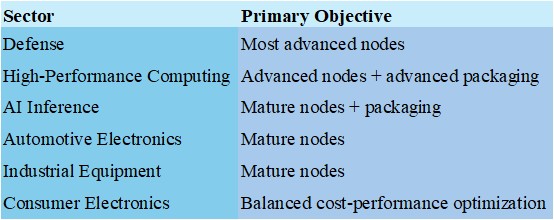
Table of Primary Chip Manufacturing Objectives by Industrial Sectors
There is no single correct answer.
Competition is shifting away from breakthroughs at a single point and toward combinations of capabilities.
Process technology.
Packaging.
Software.
EDA tools.
Materials.
Manufacturing equipment.
Together, these determine competitiveness.
But combinations are not free.
Huawei has reportedly mass-produced 381 chip products under what it calls the Tuo Principle framework, demonstrating that this technological path can support large-scale industrialization.
Yet the essence of LogicFolding is using design innovation to compensate for manufacturing limitations.
That means Huawei must invest more heavily than competitors in chip architecture, circuit design, and system optimization.
Those resources could otherwise have been deployed elsewhere.
More importantly, as policy increasingly steers the industry toward domestic substitution, the range of choices available to commercial firms narrows.
The third phase of China's National Integrated Circuit Industry Investment Fund was launched in 2024 with a capital pool of RMB 344 billion (approximately $49 billion).
Where that money flows will influence which projects receive resources and which do not.
This is no longer purely a market selection process.
It is a policy selection process layered on top of market selection.
The Real Split Is Not Technological—It Is About Objectives
Many people assume China's semiconductor industry is experiencing a debate over technology roadmaps.
The deeper transformation is that objectives themselves are beginning to diverge.
For years, the entire industry pursued a common destination.
Advanced nodes served as the universal direction.
Today, different participants are serving different needs.
National security requires one answer.
Market competition requires another.
The two are not necessarily incompatible.
But they are no longer perfectly aligned.
ASML's share of revenue from China is expected to fall below 15% in 2026.
Restrictions are tightening.
Yet those restrictions are also accelerating the construction of a parallel ecosystem within China.
The crucial question is whether that ecosystem becomes a form of self-sufficiency—or a form of self-isolation.
An industry observer once described the situation to me in a way that felt remarkably accurate:
"China's semiconductor industry now operates on two clocks. One is the national security clock. It moves quickly because it cannot afford to wait. The other is the commercial clock. It moves slowly because yields are still low, costs remain high, and customers are reluctant to pay."
The fact that these two clocks are no longer synchronized is the true meaning of the split.
Conclusion: When an Industry No Longer Has a Single Destination
Over the next several years, one of the easiest mistakes observers can make is asking whether China is still pursuing advanced process nodes.
The answer may be:
Some players must pursue them.
Some players do not need to pursue them.
Some players will pursue both paths simultaneously.
The most important development is not whether a specific node is achieved.
The more significant shift is that China's semiconductor industry is, for the first time, beginning to accept that different objectives may require different technological paths.
But that acceptance comes with costs.
Resources become fragmented.
Talent becomes contested.
Commercial decisions become distorted by policy considerations.
The same company may end up operating with two sets of books—one designed for government stakeholders, and another designed for investors.
China's great semiconductor split has only just begun.
References
- Huawei Technology Roadmap & LogicFolding Announcement, IEEE ISCAS 2026, May 2026
- SMIC Annual Report & Earnings Calls, Q4 2025 / Q1 2026
- Reuters Exclusive Report on China's 50% Domestic Equipment Requirement, 2026
- TrendForce Mature Process Capacity Report, 2025
- China Semiconductor Industry Association Talent Development Report, 2026
- SJ Semiconductor IPO Filing & Advanced Packaging Analysis, 2026
- ASML Revenue Forecast & China Market Exposure Analysis, 2026
- Kiwoom Securities SMIC 5nm Yield and Cost Analysis, 2025
Lucas Reinhardt
Senior Semiconductor Analyst
Lucas Reinhardt is a semiconductor industry analyst focused on advanced manufacturing, memory technologies, and AI infrastructure. His work explores how supply chains, fabrication technologies, and capital investment decisions reshape the global computing landscape. Before becoming an independent analyst, he spent years covering the European semiconductor ecosystem and industrial technology markets.
Related articles: The End of Semiconductor Scorekeeping
Recommended for you